
Postmortem
Translation by Kabir Altaf of an excerpt from a story by Bilal Hasan Minto
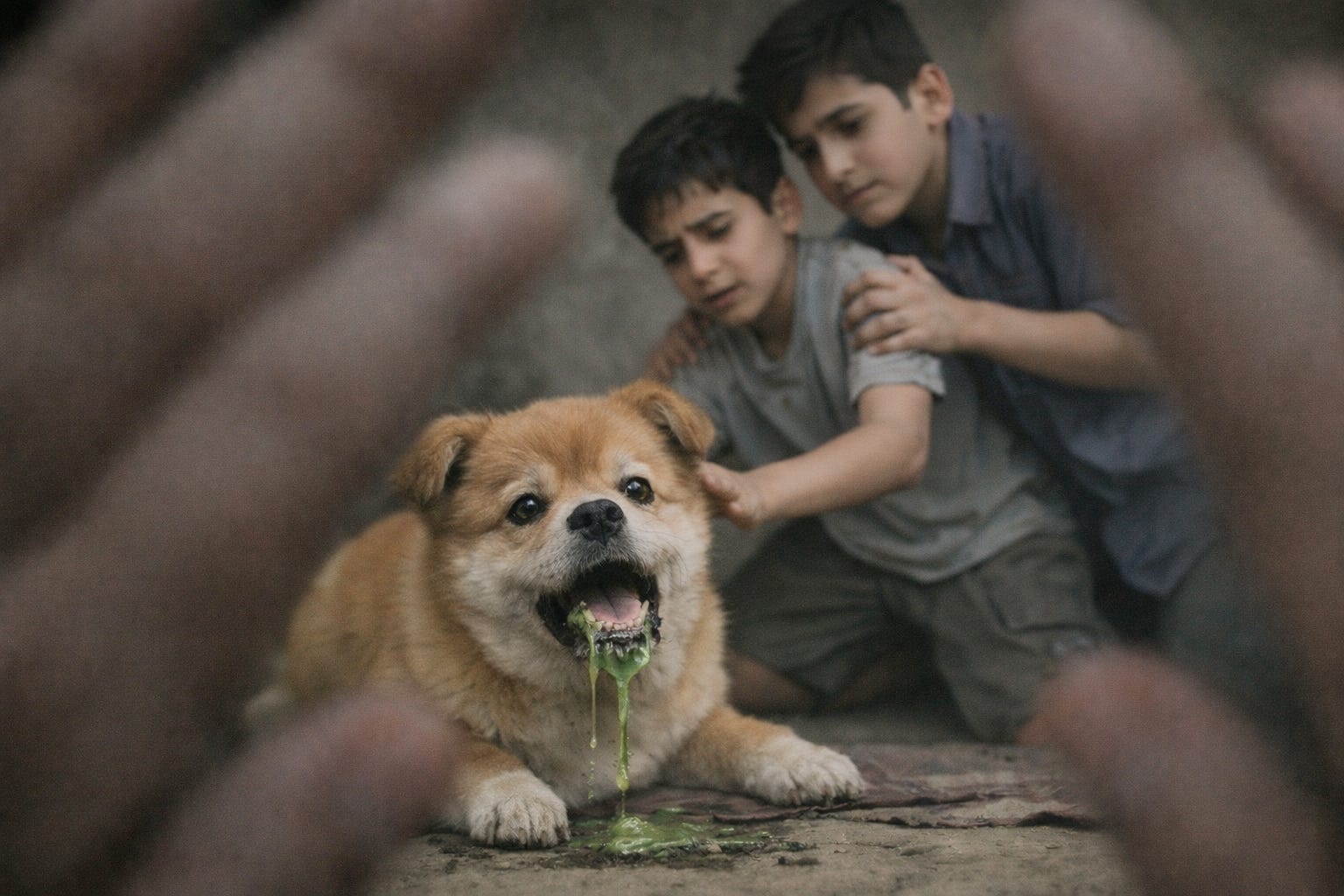
It was a frost-laden evening in December when our Happy stopped eating. Naveed Bhai went into the garden, where Happy was sitting quietly tied to his post, to cover him with a coat. Happy looked at Naveed Bhai with barely opened eyes, and smiled. Then he moved his tail weakly from left to right. That was it. This was unlike him. He didn’t stand up and wag his tail vigorously, or play around with Naveed Bhai. Naveed Bhai was worried.
“Happy, Happy,” he cajoled.
Happy didn’t even open his eyes and just moved his tail from right to left. It was clear even that was not easy for him and he did it only out of love for Naveed Bhai. Naveed Bhai’s eye fell on his bowl. Happy’s afternoon meal was sitting there untouched,flies buzzing around it.
That night at the dining table, Naveed Bhai told Abba about Happy’s condition and said with concern it seemed he was ill because he hadn’t touched his afternoon meal. Abba said maybe he hadn’t liked it.
“But he gets this food every day,” I said, “and he always eats it.”
“Perhaps that’s why. If you got the same thing every day you would get tired one day too, wouldn’t you?” Abba said.
“Oh! So now I have to prepare a new feast for him every day!” Ammi said angrily. She hated Happy.
“Anyway, let’s see if he eats anything tonight,” Abba said, wanting to end the conversation.
“But why didn’t he move? I even had to put on his coat while he was lying down,” Naveed Bhai said anxiously.
“Maybe he has a cold. It’s freezing. If he doesn’t eat at night or is the same tomorrow, take him to Dr Walter,” Abba said.
That evening, Naveed Bhai and I took Happy his meal. Naveed Bhai had asked Ismail to make qeema and soft rotis. The rotis had been crumbled and mixed with the qeema,everything topped with yogurt. We had prepared a very delicious meal for our beloved Happy — Naveed Bhai had even given it a name: ‘Happy mix.’ I had garnished it with some cilantro so that the elegant presentation and the cilantro’s freshness, smell, and color would attract Happy’s attention.
Happy was not generally fed late because then he would sleep through the night. Although he didn’t do much anyway, it was still reassuring that Happy was awake while we were fast asleep. Aside from this false comfort, there wasn’t any point in keeping him up all night. Naveed Bhai thought it was cruel to do that and allow him only two meals while we had three and could take fruits and drinks from the fridge whenever we wanted besides. But Abba had consulted some reference book to decide the rules for Happy’s living and eating so Naveed Bhai had to obey this regimen of two meals a day.
Happy didn’t bark much. Sometimes,he would if there was a special reason,and we would be thrilled. We could never figure out what motivated it — the impetus seemed mysterious. He wouldn’t bark at any passing stranger nor at any cat or mouse. He did bark at cars speeding away from him but not at those approaching. He would run after the departing cars, barking all the while, and if they stopped, he would immediately do so as well,stop barking, and turn around to run inside the house. Abba had told us Happy thought departing cars were running away because they were afraid of him. He felt brave thinking they were afraid and pursued them,relishing their fear. So when they stopped,he turned around quietly,disappointed they weren’t scared anymore.
It was not just Ammi who disliked Happy. Happy also disliked Ammi but despite the fact that she was always scolding him, he never barked at her.
“Don’t sit in the verandah,” Ammi would say for no reason although the verandah was an open space with only two or three chairs. And it wasn’t even as if Happy would sit on those chairs.
“Get out of here,” Ammi would often say. She said that even when Happy was sitting alone on the lawn or in some other place.
“Don’t you dare come near me” — as if he were really fond of coming near her.
When Ammi would scold him he had to do as she said,but he would look at her and make a face. That made Ammi even angrier. Abba would always remark that there was no reason for anger. Just as she didn’t like Happy, he didn’t like her. Ammi would say at least she didn’t make a face and that making a face at your elders was extremely rude. Then to prove the point, she would say to me: “Listen, you! If I ever catch you making a face at your elders, I will skin you alive and hand you the skin” which was an obvious impossibility because human skin is very fine and cannot be removed like a bear’s or stag’s and even if that were possible there isn’t a man with fortitude enough that his skin could be removed and he would hold it quietly in his hand. The depiction of such a person cannot be found in any book of history, true or false.
“You can speak and scold him. He can’t talk, so he makes faces,” Abba had said once.
But Ammi’s question was how Happy knew she didn’t like him. Abba had responded that dogs could even smell people’s emotions and she actually screamed at Happy. Both Naveed Bhai and I had really liked this bit about ‘smelling emotions.’ Often, when guests scared of dogs came to our house and Happy would sniff their shoes and clothes, we would smugly reassure them and say “Don’t worry, he’s only smelling your emotions.” Some would relax on hearing that and some would be surprised.
Some others would become agitated as if Happy were a spy and after smelling their hidden emotions would report them to us. When such people were flustered, they might do something strange. Women would start screaming and men would begin speaking rapidly or they would walk quickly towards the door to get inside fast — leaving us, whose house it was, behind. This would sometimes, but very rarely, cause Happy to bark at them and it would appear as if he were mocking them. At such times we would be delighted to hear him bark, forgetting that our laughter would upset our guest.
Once, when such a frightened guest dashed out of the house, Happy bit him by mistake. Perhaps, he bit him out of confusion, seeing this human behaving so strangely without any reason — he had just arrived and now he was running out. The man whom Happy accidentally bit died after a few days, not from Happy’s bite but from a fatal heart attack, of the kind that frequently occurs.
The afternoon meal was still untouched in Happy’s bowl. Maybe there aren’t flies at night. Maybe they go somewhere or go to sleep, because at this time, there were none on the food. Ismail picked up the bowl and went out of the gate. He emptied it on the trash heap and brought it back. Naveed Bhai and I just stood there,looking at Happy. Naveed Bhai would call to him from time to time: “Happy Happy, puch puch.” But now he did not wag his tail or open his eyes. We would have thought he was dead if his stomach were not rising and falling with his breath.
On the wall between our house and Apa Sughra’s, a cat appeared. Naveed Bhai immediately made a sound to rouse Happy, the kind one makes with dogs, making a clicking sound and then saying “Ush.” “Happy... look there... karak, uuush.”
I was irritated and asked why he was going through this pointless exercise. Happy was hungry and still wasn’t even looking at his food. Had he ever in his life said anything to a cat or a mouse? Does he look like he’s going to start chasing the cat just because of your karak and ush? Naveed Bhai didn’t reply. He was worried.
When Ismail brought the bowl back, Naveed Bhai put the “Happy mix” in it and put it right in front of Happy’s nose so the smell would make him hungry. Happy didn’t move. Naveed Bhai picked up a piece of roti and touched it to Happy’s nose but there was no effect.
“Try feeding him by hand,” I suggested.
“How?” Naveed Bhai asked.
“You pull his mouth open and Ismail will put the food in it,” I said.
“And you? You will just watch?” Naveed Bhai asked,laughing.
“When he tastes the cilantro and yogurt,he might feel like eating,” I changed the subject sheepishly.
With much effort, Naveed Bhai opened Happy’s mouth a little — very little, hardly half an inch — and Ismail picked up a small piece of roti and tried to force it in. Naveed Bhai also kept calling “puch puch, Happy Happy, hoot hoot.”
“Puch puch,Happy Happy, hoot hoot.”
“Hurry up! I can’t keep his mouth open very long,” he said.
Happy’s mouth began to close by itself and Naveed Bhai quickly pulled his hand away. His finger scraped against one of Happy’s sharp teeth and a drop of blood appeared on it — just as these days diabetes patients take a drop of blood from their fingers to test their blood sugar. Naveed Bhai wiped off the blood on Happy’s dog coat.
“We’ll have to take him to Dr Walter tomorrow,” he said.
The next day, we had to lug Happy to the car so we could take him to Dr Walter. In the past, whenever we had to take him there, it had been difficult. Happy knew very well it meant getting needles stuck in his legs, having a thermometer pushed up his bottom, or being forced to swallow bitter medicine. In better times, when we attached a chain to his collar and took him to Dr. Walter’s house for his annual shots, he would begin growling even before reaching the gate and strive to turn back. He would suddenly become very strong and I had to pull him by the chain while Naveed Bhai pushed from behind to propel him forward. Pulling and pushing, we would get him inside Dr Walter’s gate.
Then, as dogs do in fear, he would put his tail between his legs and clasp it to his stomach. All dogs do this when afraid. It wasn’t only Happy who used his tail to cover his bottom so the thermometer couldn’t be inserted. Dogs just know to do that with their tails when they are scared. From the same fear, his urine would start to dribble out slowly and his tail would get wet from being between his legs. When we were done with the doctor, Happy would run towards home so eagerly that Naveed Bhai would often let go of his chain so he could run ahead and arrive before us.
But today the poor thing didn’t resist at all. He was just a little heavy for us because he had let himself go completely limp as if he had given up.
Dr Walter didn’t give Happy much of an examination. He took his temperature with the thermometer and barely felt around his jaw. We could tell that he did all this just for form’s sake and that he knew what the problem was with just one look.
“I’m sorry, he won’t survive,” he said.
We fell silent as if we couldn’t understand what to do or say. It had never occurred to us before that Happy could die. Today, we had to hear it for the first time and had to figure out right away how to respond.
“What has happened to him?” Naveed Bhai asked, which, under the circumstances, was the right response and appropriate question.
Dr Walter told us that Happy had an illness that was called rabies.
“Rabies?” Naveed Bhai said,scared. Maybe he knew a lot about this illness.
“Oh!” I said, echoing his fear. “That rabbit illness?” I was trying to be clever, pretending I also knew about rabies even though I only said that because the word “rabbit” sounds a bit like rabies.
“But this disease causes dogs to go mad and bite people,” Naveed Bhai said. He thought perhaps Dr Walter had made a mistake and he might change his diagnosis.
Dr Walter told us that Happy had “dumb rabies,” which was the type that was silent and couldn’t cause much panic. The dangerous kind — in which dogs bite everyone, making people go around saying “move away, move away, the dog is crazy and will bite” or “bring the gun and shoot it” — is called “furious rabies.” He said we ought to be thankful that Happy didn’t have “furious rabies.”
Naveed Bhai asked how Happy could have contracted the disease — he had had his anti-rabies shots. He still thought Dr Walter might have made a mistake and the diagnosis might change. But Dr Walter had spent a lifetime with dogs and cats. He just said that Happy had had his shots at the right intervals according to the prescribed protocol but in medicine nothing was a hundred percent and the injections don’t stand a chance before God’s will.
“Nothing is one hundred percent and especially not in medicine,” he said decisively in English.
Then he said had it been “furious rabies,” Happy would have had to be put to sleep immediately so he wouldn’t bite anyone and give it to them. But now that he didn’t have any strength and was also becoming paralyzed,there was no need. He wouldn’t say anything to anyone and would die in a few days on his own. Dr Walter specifically said it would be best to stay away from him. “He will die soon,poor thing.”
I thought that Dr. Walter had wanted to say that, from a medical point of view, Happy should be put to sleep but,seeing how sad we were, maybe he thought that instead of ending his life immediately we could let him die slowly instead.
“Happy bit Naveed Bhai yesterday,” I couldn’t keep myself from saying.
“No, no, he didn’t bite me. His tooth grazed me accidentally. It was my fault. I was force-feeding him,” Naveed Bhai spoke quickly as if he were afraid that Dr Walter might use this as an excuse to order Happy’s death.
Dr Walter raised his eyebrows.
“Did you bleed?”
“Yes, he bled,” I said.
“You must see a doctor at once,” Dr Walter said in English, which made it clear that this was an important and serious matter. He also said in English that he would call our father and tell him to take us to the doctor. He used the expressions “your dad” and “very dangerous.”
He added that if a human contracts rabies, death is certain. Anyway, what Naveed Bhai was afraid of didn’t come to pass and Dr Walter didn’t order that Happy be put to sleep.
We brought Happy home. I began to tie him up but Naveed Bhai stopped me saying “the poor thing doesn’t move anyway and is paralyzed, let him be. Let him die free.” We put him in a flowerbed along with his dog coat.
Dr Walter had called Abba and must have spoken to him in a serious manner because both Ammi and Abba looked very frightened. Abba immediately took Naveed Bhai to a hospital and they did not return for a long time. Naveed Bhai had had a massive and painful injection in his stomach. He would need thirteen more,one every day.
Naveed Bhai had heard many things about rabies or perhaps he had read them somewhere. He said that there is a microscopic insect — invisible to the naked eye. When a rabid dog bites someone, the insect gets into the person through the dog’s saliva and then travels wriggling through the body till it lodges in the brain. Then, when it multiplies, a number of strange things happen. The person goes insane. He begins to be afraid of water. He has to be tied up. He starts to bark like a dog and runs around biting people. I found this last fact extremely strange: Is it an insect or is there some little dog that gets inside a person and captures his spirit and then makes him bark and bite other people for no reason? How could this be?
I was very surprised and frightened by these revelations. For the next thirteen days — until Naveed Bhai had gotten all his injections — I watched him closely. Had he become afraid of water? Did he hide alone somewhere and bark? After he had taken a shower, I would go into the bathroom to see if he had really bathed or had only pretended. Was the floor wet or not? Were there any drops of water anywhere? And when he lay down to sleep at night, I would listen at his door to hear if he was barking softly. I should have realized that even if he had rabies, it had come from Happy. So first it was “dumb rabies,” and also, Happy didn’t bark, so why would Naveed Bhai?
Later, I found out that nothing like this happened. Some vile person had spread this rumor that if you get rabies, you turn into a dog. This was untrue. A person infected with rabies doesn’t become a dog. Yes, it is true that he becomes afraid of water. But it is not so strange that humans become scared of some things. One of the best known Urdu poets, Mirza Ghalib, even wrote in his thick book of poems that because he had been bitten by human beings he became frightened even by his own reflection in the mirror — just as someone who is bitten by a dog becomes afraid of water. But a person bitten by a dog does not actually fear his own reflection in the water. Because he has contracted rabies, something happens to his throat that makes drinking extremely painful. When he sees water, he begins trembling, scared that he might have to drink it.
***
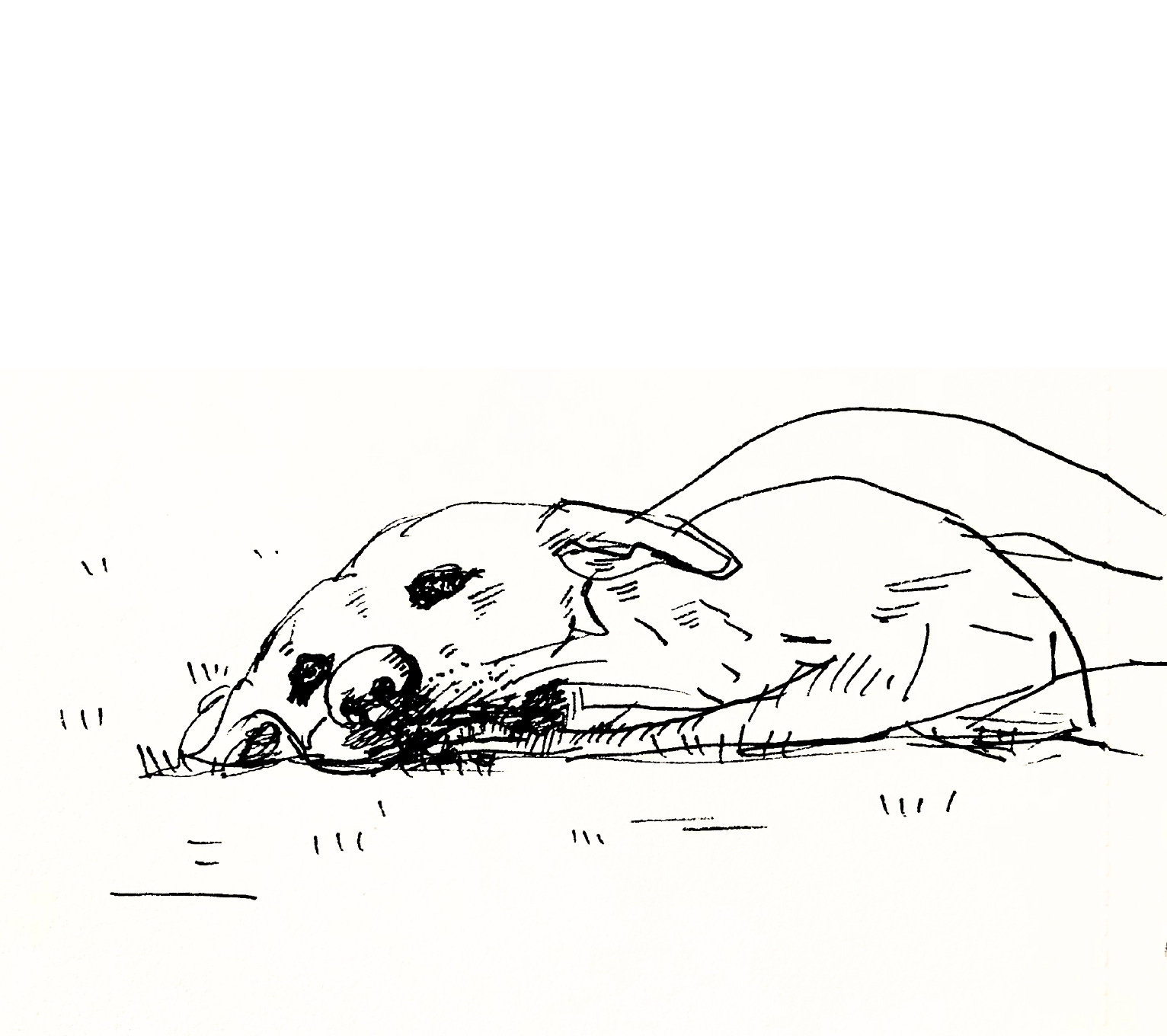
We had left Happy alone to do whatever he wished, roam wherever he wanted. We continued giving him food — three times instead of twice a day. But now none of these things mattered. He neither moved nor ate anything. He was just wasting away from one day to the next. Sometimes, he would open his eyes and look off into the distance as if death were slowly approaching him, dancing a frightful dance, relaxed, on its own volition, enjoying it.
Naveed Bhai did not become afraid of water; he did not bark. He continued to bathe and drink water. Dr Walter had said that Happy would die within ten days but that didn’t happen. He lived for fourteen days because nothing is one hundred percent as Dr Walter had said in English.
On the fourteenth day, just when Naveed Bhai had returned home after getting the last injection in his stomach, Ismail came running.
“Happy is dying,” he said.
“How do you know?” I asked.
“It just looks like it,” he said.
The three of us went running to the backyard, where Happy was lying in the flowerbed.
“Stay away. Don’t get close,” Ammi yelled from behind us as if along with Happy’s soul, his rabies germs would also emerge from his body and attach themselves to us.
Happy was breathing heavily and his eyes were closed. After every little while, his body shuddered. We stood watching him.
“He’s close to the end,” Ismail said in a whisper.
I didn’t know what to do. Tears welled up in my eyes and I covered my face with my hands. From between my fingers,I saw Naveed Bhai helplessly petting Happy’s head. Suddenly,Happy trembled. Ismail quickly stepped forward and pulled Naveed Bhai back. Still peeking through my fingers, I saw that Happy had raised his head. His neck stiffened, and his mouth fell open. From his open mouth, a thick green mucus dribbled out.
Then Happy fell still and his breathing stopped.
“He’s gone,” Ismail whispered.
***
Dinner that night began in silence. I couldn’t eat. Partly out of sorrow and partly because of that green saliva that kept reappearing in my imagination. It was a disgusting green saliva and certainly contained many rabies germs.
While eating dinner, whenever I thought of Happy’s saliva, I would stop chewing. Naveed Bhai was eating silently, but slowly. Ammi looked pleased but it seemed to me that even Abba was not too bothered and he was only quiet out of respect for our grief. When I looked once or twice at Abba, I was surprised to see him glance at Ammi, smile, and signal towards us with his eyes as if he found it very amusing that Naveed Bhai and I were mourning Happy’s death, silent and uninterested in our dinner.
Ismail would go back and forth from the kitchen, bringing hot rotis. When Ammi saw that Naveed Bhai and I were disinterested in our dinner, she told Ismail to stop making roti for us and to just make it for himself. Ismail said that he wasn’t hungry. I looked at him and so did Naveed Bhai. He looked back at us and after a moment asked, “When is the funeral, Naveed Sahib?”
Hearing this, Abba and Ammi burst out laughing. Naveed Bhai, Ismail, and I were shocked. There had been a death in the family, the death of our beloved Happy who had been with us for so long.Was this anything to laugh at? It’s true that Ammi didn’t like Happy, but was it necessary to laugh like this at his death? And Abba? Why was he laughing? He didn’t dislike Happy.
Ammi, half laughing and half scolding, told Ismail not to say stupid things — funerals were for humans and not for animals. I looked at Naveed Bhai to see if he would say something but he just kept chewing quietly. Perhaps he didn’t want them to think that he didn’t know about these adult things — that funerals were only for humans. Maybe he kept quiet so that Ammi and Abba wouldn’t laugh at him. But just a moment earlier, he had been looking at them with as much astonishment as Ismail and I.
Mustering up the courage, I said that there would be a funeral and it would be tomorrow. In the afternoon. We would bury Happy in the back lawn. We would dig a grave there and burn incense.
Now Ammi became furious.
“Don’t you dare,” she said. “Don’t even think about it. Tomorrow Grace and mali1 will get rid of the dog far away, near China Basti.”
I couldn’t take anymore. My eyes filled with huge tears and I began to cry.
“I will hold his funeral! I will! I will! I will! Try and stop me!” Saying something like this, I got up and ran into my room.
“I will break your hands! I forbid anyone from doing anything like this!” Ammi shouted after me.
I sat crying in my room. After a while, Naveed Bhai came in. He stood there watching me cry, and then said: “Even humans are not buried at home so how can we bury Happy here?”
I said that there were huge and elegant graveyards for humans to be buried in. “Has anyone made a graveyard for dogs?” I asked.
“You are right. Nobody has made one,” he said.
“Why is Ammi talking about China Basti? Why is she talking about dumping Happy there?”
“Who? Ammi? Did she say to leave him near China Basti?”
“Why? Why near China Basti? Why not outside near our house?”
“The China Basti people will bury him somewhere or throw him somewhere far away.”
“Why would they do it? Because they are sweepers?”
“Yes. They know how to do this work.”
“Disposing of dogs’ bodies? They are Christians. Christians love their dogs and cats a lot.”
“Christians love their pets a lot? What makes you think that?” Naveed Bhai asked in surprise.
“English people are Christians. Haven’t you seen in movies how well they treat their dogs? They even let them lick their faces. And when Happy licked your face that time, remember how Ammi screamed?”
“Hunh,” Naveed Bhai said, “it seems the important thing is being English, not being Christian.”
“Maybe. But listen. Dr Walter is an animal doctor. He chose to treat animals, not humans.”
Naveed Bhai heard this and laughed a little.
“You are laughing? You’re laughing at a time like this? These people were also laughing. Did Happy not mean anything to them?”
“These people?”
“Your mother and father,” I said with anger.
Naveed Bhai smiled. Then he said: “Let’s decide in the morning what to do with Happy. We’ll leave him in the flowerbed tonight and put a cloth over him.” Hearing that Happy’s body would remain on the lawn all night made me tremble but I nodded.
The next day was a school day so there was not much time for debating Happy’s funeral arrangements. I felt this was very important but Ammi and Abba — and even Naveed Bhai — were entirely so involved with their own affairs as if there wasn’t anything left to discuss. I was surprised that Naveed Bhai was brushing me off when he was not like this and had seemed to be on my side last night.
I continued having my breakfast, getting up every little while to look outside to see if mali had come. Ammi and Abba told me to get ready quickly and not to be late. I said: “Tell me first what we are going to do with Happy.”
“What do you mean what are we going to do?” Ammi said.
“The funeral and everything, the burial.”
“Now stop this foolishness. Dogs and cats don’t have funerals. The joke has gone too far.”
“Joke? Joke?” I screamed. “Someone’s death is a joke? Are you people human or… or...”
“Or what?” Ammi asked angrily.
“Or… or...” I stepped back a little. “Or dogs!” I said, which was considered a huge insult in our family. Uttering it, I ran outside.
But I had said “dogs” looking at Naveed Bhai, eating his egg, because, for one, I was angry at him for not saying anything in my support and second because cursing at him was a lesser offense then cursing at Ammi and Abba.
Ammi leapt after me. I ran quickly through the kitchen door into the back yard. Unconsciously, I ran towards that flowerbed where we had left dear Happy’s body. But as soon as I saw that place — where dear Happy’s body should have been — my feet stopped. Happy’s body was missing. There had been no funeral and Happy’s body was missing. How did our beloved Happy’s lifeless body disappear?
I was frozen in place when Ammi grabbed my ear and twisted it roughly.
“Come inside! Brat! You dare to curse at me! Shameless!”
As Ammi pulled me around, I saw mali and Grace walking in. There was a cord in mali’s hand.
“Did you get rid of it?” Ammi asked.
“Yes ma’am, We’ve dumped Happy,” mali said.
“Why have you brought this cord, mali? Are you out of your mind? Throw that dirty cord away.”
The wretched mali laughed embarrassedly and glanced here and there as if he were looking for a trash heap on our lawn on which to throw the cord. Then, when Ammi turned her attention to me, he stuffed the cord into his pocket.
I started crying loudly. Ismail and Naveed Bhai were standing outside the kitchen door. Ismail’s eyes also welled up with tears. I continued crying and wailing loudly: “Traitors, liars, cruel people!
“Shut up!” Ammi said.
One advantage of crying was that Ammi didn’t hit me. She led me inside by the ear, then let me go. Still crying, I went into my room to get ready for school.
***
That day, after coming home from school and having lunch, I went to see Mazhar and Talat and told them this sad story. Mazhar had never liked Happy so he didn’t express any sorrow but said that we should do a postmortem on him.
“Postmortem?”
“Yes, when someone dies, a postmortem is required.”
“Why?”
“It just is.”
“How do you know?” I asked.
“Black Hand told me.” As usual, he referred to that terrible, unseen force that told him all the hidden secrets of the universe. He constantly mentioned him to impress and scare us.
“Tell Black Hand to tell me this himself,” I said. “Where’s Black Hand? Bring him here.”
“How do you do a postmortem?” Talat asked, nervously, because he was scared that my disrespectful comments would annoy Black Hand.
“I’ll tell you. First let’s go find Happy,” Mazhar said.
I didn’t object further, thinking that OK, even if there had been no funeral, no burial, at least there would be some type of ceremony for dear Happy’s death. Why not a postmortem? That would do.
I had just a vague idea of where Happy’s body would be — near China Basti, on some trash heap. It wasn’t very difficult to quickly find that trash heap — at the furthest edge of China Basti, very near Grace’s house. Obviously, Grace had had Happy’s body placed there so that she could take it after returning from work in the evening. I didn’t know what she might want with the body but I knew that many people in the world found different uses for animal parts — bear paws, rhino horns, elephant tusks. I didn’t know what parts of dogs were used and for what purpose. There must have been some — the tail or the ear or something. That is why Grace had Happy thrown on a trash heap right near her house.
Flies were buzzing around Happy — especially over his open mouth. Regular flies and huge loud fat ones as well. There was no dead animal smell because it was winter and Happy had not been dead for long so his body had not yet decomposed. However, the smell of the trash itself, wet and dense, rose around us like steam.
“Tsk, tsk,” Mazhar said, “Poor thing, his eyes are still open.”
“Even people’s eyes often remain open and have to be closed by hand,” I said, stung, because I sensed that Mazhar’s remark reflected contempt and I saw no reason for Happy to be given a lower status than a human or any other creature.
“It’s possible that even Black Hand’s eyes will remain open when he dies,” I got back at Mazhar.
“Black Hand will never die!” Mazhar said angrily.
“Should we go ahead with the postmortem?” The coward Talat immediately interjected and changed the subject.
“Wait a minute,” Mazhar said. He moved Happy’s tail with his hand.
“That’s gross!” Talat whispered, “he’s touching it.”
I didn’t think Mazhar should do that either. “At least, don’t touch him,” I said.
Mazhar ignored us and continued staring at Happy as if he were really enjoying looking at his body.
“What’s a postmortem anyway? How will you do it?” I asked, exasperated.
Mazhar signaled us to remain silent, stood up straight, and closed his eyes. He was talking to Black Hand. Whenever he spoke to Black Hand he would close his eyes and become silent like this. We stood watching him. After a while, he opened his eyes and walked slowly once around Happy’s body — that is, around the trash heap. Then he touched Happy’s tail once more and lightly pulled one of his ears.
“OK,” he said, “let’s go.”
“Aren’t you going to do the postmortem?” I asked, surprised.
“It’s done,” Mazhar said.
“That’s how it’s done?” I asked, “that’s it?”
“That’s how it is for dogs.”
“And humans? And other animals — tigers, or camels?”
“That’s different. You have to rip the stomach open with a knife,” Mazhar snapped. “Let’s go now.”
I screamed that he was lying. He had used this postmortem as a ruse to make me bring him to Happy so that he could play this weird game with his body. He was lying that dogs’ postmortems were conducted by moving their tails and walking around their bodies. Although, after hearing that the postmortem of humans and other animals required cutting the stomach open with a knife, I no longer wanted dear Happy’s to be like that but I was still disappointed that Happy’s postmortem ceremony was as insignificant as what Mazhar had done.
“Let’s get out of here. This is how dogs’ postmortems are done. Black Hand has told me,” Mazhar said again.
“Come on, come on,” Talat said quickly.
***
At home, everything was as usual. Ammi and Abba were resting and Naveed Bhai was out enjoying himself with his friends. Only Ismail was still sad. I told him that I had seen Happy’s body and also that I was suspicious that Grace would cut him into pieces and use them.
Ismail agreed. He said that many people use dead animals for magic purposes and it’s possible that that’s what Grace intended.
“Bitch!” I said. “Does she have no heart? Christians are supposed to love animals.”
The next morning, when I came outside for school, the mali was working in the flowerbeds. Yesterday, this man, with Grace’s help, had tied beloved Happy’s body with a filthy cord and dragged him along the dirty tar road and thrown him on a trash heap near China Basti, close to Grace’s house. Now she would be cooking Happy’s tail or paws to eat them or do some terrible magic.
The mali looked at me and grinned with his big yellow teeth. I wanted to stuff his face with that same green mucus that had spilled from Happy’s mouth.
“Mali, I pray to Allah that you die as well!” I screamed loudly and ran towards the gate to go to school. But this wasn’t enough. I wasn’t satisfied. I turned, before the gate, and screamed again.
“And when you die, I will rip open your stomach myself and postmortem you!”
***
Bilal Hasan Minto is a lawyer, teacher, filmmaker, and writer. He is the author of Model Town, a collection of Urdu short stories and of a short play Glad Tidings. He has also written and directed four films.
Kabir Altaf is a musician and musicologist. His book A New Explanation for the Decline of Hindustani Music in Pakistan was published from Lahore in 2024 and from Delhi in 2026 with the title The Decline of Hindustani Music in Pakistan: A Social History. Kabir holds a degree in Dramatic Literature from George Washington University. His book reviews can be read on his SubStack “Thoughts of a Bibliophile”.
Gardener